Friday, June 3, 2011

Yippee…the Quimper Faïence Museum is Back in Action !!!

I know…I know…I’ve hardly done any blogging for the past month…but I’ve been busy…doing this, that, and everything else except writing. But I wanted to interrupt my stupor to share some great news…the Musée de la Faïence in Quimper will re-open to the public on June 6, 2011!

The museum first opened its doors in 1991 and regular readers of our Quimper-devoted website…www.oldquimper.com…will no doubt remember the photographs of the many spectacular expositions that have been mounted there…each encompassing a specific theme to take advantage of the more than 3500 pieces in the museum’s collection. Quimper’s Musée de la Faïence is a private museum and, therefore, was dependent upon the support of outside benefactors…local enterprises, banks and insurance firms, etc…for its operating expenses.  In the spring of 2007, four of the five businesses that had underwritten the cost of bringing forth those marvelous expositions were caught in the global economic slowdown and had to withdraw their support…forcing the museum to suddenly and sadly close its doors.

During those four years many different avenues were explored…until, finally a solution was found and the museum can open once more. Here’s the cover of our invitation to this evening’s opening ceremonies…
0611odettaexposition
The exhibit is entitled Odetta…Les Grès d’Art de Quimper…translation: Odetta…the Stoneware Art Pottery of Quimper.

Since its opening, the Musée de la Faïence has been to a Quimper collector what Cooperstown's  Baseball Hall of Fame is to a Little Leaguer.  Heaven on Earth.

To stimulate economic growth, the French government recently initiated a system similar to what many U.S. universities call an endowment fund. Immediately recognizing the implications, Jean-Yves Verlingue...who from 1956 to 1983 owned the HB factory/Les Faïenceries de Quimper...sprang into action. The tax benefits connected to the endowment fund...fond de dotation in French...suddenly made fund-raising efforts on behalf of the museum much more interesting and...voila...it will at last be open to the public once more.

Contributions from individuals are welcome as well...and though I hear you saying "But there's no tax benefit for me because I'm not subject to paying French taxes"...there is a roundabout, but very real benefit that comes from having such a prestigious museum dedicated to the subject of your collection...it adds an incalculable value to your collection.

So, FYI...for as little as 50 euros,  you can contribute to the Fonds de Dotation du Musée de la Faïence de Quimper and assure the museum's continuation...not to mention that contributors enjoy free entrance, invitations to events, etc. Contact me if you would like further information.

Stay tuned for more behind the scenes adventures of The Meadows Collection…or check out the results at www.meadowscollection.com

Sunday, May 1, 2011

May Day in Paris

The first of May is a holiday in France…it’s the day officially set aside for the observance of the Fête du Travail…their version of Labor Day. But nowadays that aspect of the holiday has come to be somewhat overshadowed by a flower…for it’s also the Fête du Muguet…the day when everywhere you look, you see muguets de mai…also known as lilies of the valley. They grow wild out in the woods, but on the first day of May, they invade the city.

Here’s the view outside our window:

Muguet1 It is customary in France to offer friends and family a small bouquet of muguet as a gesture of caring and as a way to celebrate Spring. This harks back to King Charles IX when,  in 1561, he offered all the ladies of the Court a sprig of muguet. Actually, the practice harks back even further…back to when May 1 was New Year’s Day on the Celtic calendar and Celts would give sprigs of muguet to each other as tokens of good luck. Today, it has evolved into a fund-raising opportunity and an enterprising young lady by the name of Lara has set up her stand on the street below one of our windows. Think of it as a sort of French take on the traditional lemonade stand. This is the one day when it is permissible for anyone and everyone to sell flowers on the street without a proper license.

OLYMPUS DIGITAL CAMERASunday strollers along Pont Marie welcomed this impromptu stand and took advantage of the opportunity to purchase some sprigs of muguet…a symbol of hope and happiness.
OLYMPUS DIGITAL CAMERAAny other day and the merchant would have been “run out of Dodge” in less than five minutes!

A symbol of humility, early in the twentieth century, French labor union leaders wore a sprig of muguet in their lapel as a way of indicating their allegiance to the cause, but today that association has been long-forgotten. Muguet is instead used to convey affection and along that vein, it is also the traditional symbol for thirteen years of marriage…known as les Noces de Muguet.

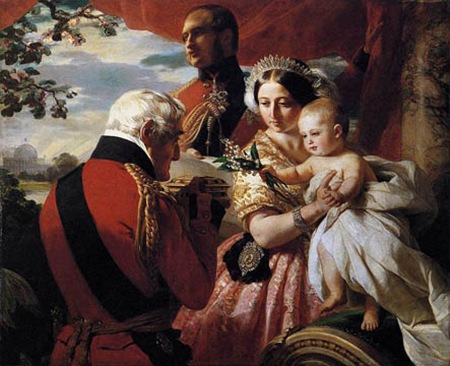
The custom of May Day muguet-giving is not confined to just France…muguet is the national flower of Finland and the painting by Franz Xaver Winterhalter shown below was commissioned by England’s Queen Victoria to commemorate May 1, 1851…that date signified the opening of the Universal Exhibition in London as well as the birthdays of two of those pictured…her son, Prince Arthur, who is holding a sprig of muguet and his godfather, the Duke of Wellington…May3 The muguet plant is highly toxic, however…you are supposed to wash your hands carefully after touching any portion of it…so it might be better to offer a loved one a pastry version…
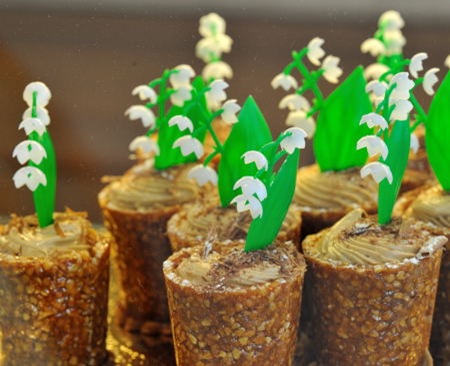
May2…like these yummy little cakes topped with pseudo-muguets! And so we wish you a Bonne Fête du Muguet!

Stay tuned for more behind the scenes adventures of The Meadows Collection…or check out the results at www.meadowscollection.com


Sunday, April 24, 2011

Happy Easter/Joyeuses Pâques

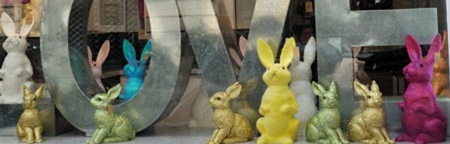
love bunnies
Joyeuses Pâques is French for Happy Easter…and as many of you sit down to your festive holiday brunch,  here’s a bit of the history of how eggs, rabbits, and dyed marshmallow peeps came to be associated with the occasion. Yes, today is when Christians celebrate the resurrection of Christ, but the holiday actually has roots that go much further back. Back to when the coming of Spring symbolized a sort of re-birth after a long, hard Winter.

To the ancient Egyptians and Romans, eggs were a symbol of vitality and it was customary to offer painted eggs as gifts to commemorate the changing of the seasons. The tradition was reinstated by the Christians as a way to make use of all the eggs that had been stockpiled during Lent when the eating of meat and eggs was forbidden.  Children immediately took to the challenge of finding the brightly colored eggs that had been hidden. The French explanation for how the eggs got there went like this: normally the church bells rang each day to invite the faithful to services, but during the week before Easter, the bells were silent from Thursday evening until Saturday evening. That’s because the church bells had flown to Rome to get eggs. On their return back, they would drop the eggs so that they could be found by good little girls and boys! By the eighteenth century, French children were finding eggs that had been emptied and re-filled with chocolate.
In Germany, the eggs were left by a hare or rabbit…a long time symbol of fertility and re-birth. German settlers to the United States brought this custom with them and voila…the Easter Bunny is born! Other immigrants brought with them several related customs…like burying a colored Easter egg at the foot of a vine or row of crops in the hopes that the crop yield will be quicker and greater…or believing that if an egg is buried for 100 years, the yolk will turn into a diamond!
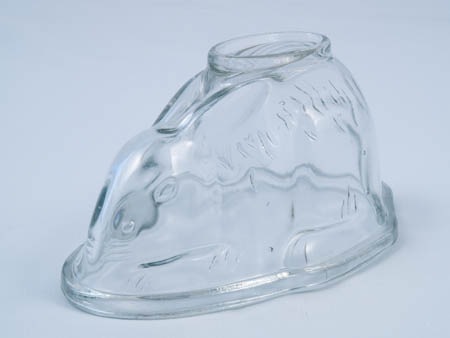
With the arrival of the Industrial Revolution, Easter-related molds were produced and mass-marketed. The molds were both for general culinary purposes…like this rabbit-form glass mold…probably for pâté….


OLYMPUS DIGITAL CAMERA…but many more were produced for making chocolate…like this wonderful egg with a man-in-the-moon motif…
eastereggmaninmoon 
…or an egg to commemorate the rooster who helped to produce all those eggs…
easterrooster2
Chocolate is now firmly entrenched into the French customs surrounding the celebration of Easter…reportedly at least 20% of the nation’s annual sales of chocolate occurs during this time. (And that’s no small amount since 97% of the French eat chocolate at least once a week).
And of course, it’s Easter chocolate as only the French can conceive…here are some examples for your holiday enjoyment…
…as seen in the windows of Lenôtre……a bunny wearing a toque de cuisinier…OLYMPUS DIGITAL CAMERA …waving gaily as he flies in a chocolate balloon over a chocolate Paris…
OLYMPUS DIGITAL CAMERA …priced at 390 euros, one would have to be a very, very good little girl or boy to find one of these creations!
Over at the next window, one finds his friend, the rooster…OLYMPUS DIGITAL CAMERA…who is much smaller, and not quite so expensive…but the chocolate map is much smaller as well and the Eiffel Tower that he flies over is not in chocolate as it is for the flying bunny. A very strong incentive to be really, really good!
Over at Patrick Roger’s…OLYMPUS DIGITAL CAMERA …there’s a chicken with chocolate “feathers” and a white chocolate “nest” and the shells of real eggs that have been filled with chocolate.
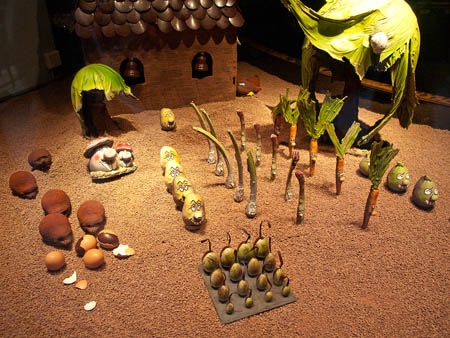
Last year, Monsieur Roger created an amazing chocolate “vegetable patch”…OLYMPUS DIGITAL CAMERA
…with cheerful Easter potatoes…
OLYMPUS DIGITAL CAMERA 
…rows of smiling carrots…OLYMPUS DIGITAL CAMERA
…and several marauding hedge hogs making quick work of shelling some chocolate-filled eggs…OLYMPUS DIGITAL CAMERA …and of course, except for the egg shells…every bit of the scene…including the farm house…was in chocolate!
And to think that I used to marvel at a Cadbury egg…Joyeuses Pâques!
Stay tuned for more behind the scenes adventures of The Meadows Collection…or check out the results at www.meadowscollection.com
Tuesday, April 19, 2011

The View From My Window…Dimanche des Rameaux

Well, I’m still wrestling with computer issues. For now, I think the computer itself is functioning, but the keyboard has suddenly decided to go haywire….and at the moment, there is absolutely no correlation between which key is pressed and what symbol appears!
So less words…more pictures.
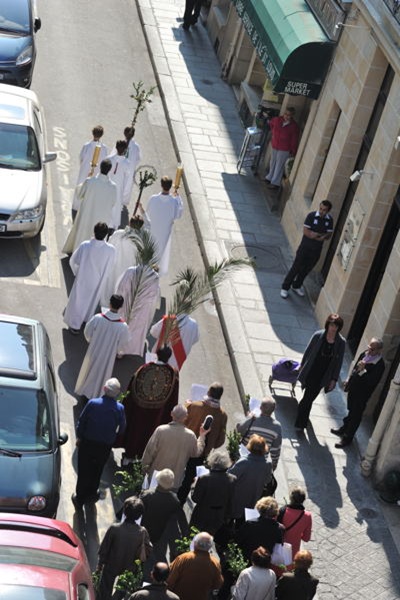
Early in the morning…à table in our fourth-floor, walk-up pied à terre…this was the view from my window last Sunday…
procession1It’s not terribly unusual for us to hear music from la rue down below…strains of Piaf from an accordion player on the corner…or an impromptu jazz trio on the bridge that connects us to “the other island”…but this time, there was a definite difference in what we heard.


What the…?  Ah, yes…it was Palm Sunday. Only here it’s called  Dimanche des Rameaux…Branch Sunday…and while there was one palm leaf…

procession2 …held aloft by the prêtre…be-splendid in an embroidered crimson velvet cloak…

…the other participants are holding branches of buis or boxwood…
procession4The parishioners follow…
procession3  …forming a procession of faithful…that sings its way toward our neighborhood church. We can smell the mixture of incense, candles, and foliage. With each participant carrying a branch, from our vantage point, it’s sort of like a horizontal bush chanting its way up the street.
procession5
Different types of branches are used in different parts of France. Here, it’s boxwood, but other regions might use laurel branches…in Provence, an olive branch is carried as a symbol of peace and abundance. It’s all part of a custom that dates back to the ninth century.  Once the procession reaches its destination and is inside the church, the branches are ceremoniously blessed to signify vitality. Some are then placed on the graves of the departed and others are kept at home…until the following year, when they are brought back to the church to be burned as part of the ceremonies for Ash Wednesday and the beginning of Lent.
Where does one find all that boxwood?

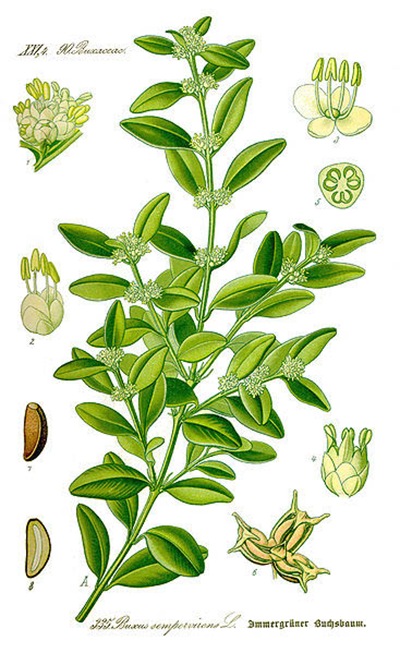
Buxus sempervirens is its botanical name…

processionboxwood     …and throughout Europe it has been used for centuries in various handicrafts…carved into countless chess pieces or…duh…boxes.

Even though we are in the middle of the big city, it was not difficult to find boxwood branches…boxwood is a common component of a traditional French garden and we were lucky enough to befriend the gardeners at the nearby Bibliotèque Forney…an amazing library devoted to the Decorative Arts…
procession8…as well as a wonderful place to sit and admire the architecture of the building in which it is housed…constructed between 1475 and 1507 as the Parisian residence of the Archbishop of Sens.

A French garden often consists of low hedges that form a decorative pattern…
procession6 …and, in keeping with that old saying…one man’s hedge clippings is another man’s symbol of vitality…
procession7Ahhhh…Paris in the Springtime…who needs words, anyway?

Stay tuned for more behind the scenes adventures of The Meadows Collection…or check out the results at www.meadowscollection.com
Monday, March 21, 2011

County Fair…Parisian-Style

First of all, I should explain the extraordinary delay between this and my previous posts. We’re in the midst of a computer-related nightmare. It all started when the computer guru Chez Nous…aka Hubby Dearest…decided after the latest of several malware attacks that that was it…we were done with PCs. He then proceeded to tweak my Scottish sensibilities by running out and buying his and her Macs. The man at the Apple store assured him that the transition would be a piece of cake and that furthermore, the writing programs that I need…which are not offered in Mac versions…could still be used…because the new Macs can be partitioned to accept Windows-based programs. 

Ha! Well, it’s been a month since our new toys arrived and all they’ve done is create one problem after another. My trusty seven-year-old PC is sulking after being deemed incompatible and has been fiddled with so much that now it’s un-WiFi-able. I am reduced to writing to you now on a vintage, no-frills, ex-French government agency issue laptop. How old is it you ask? Well, the “intel inside” is so old that it has to be jerry rigged to be able to go online and the celeron might as well be celery.

So suddenly incommunicado…I did what any one else would do…I went to the county fair.

countyfariposter Each year, for nine days, the farmer that lurks within each Parisian goes amuck and propels itself to the Salon International de l’Agriculture. It’s the Parisian version of a county fair!

The event officially had its beginnings back in 1870, although, unofficially, agricultural competitions go back much further in French history.  The emphasis of the salon was initially on farm animals but over the past 141 years, it has  evolved to include all sorts of produits du terroir, such as wheat, milk, and wine. It moved to the current venue, the exposition center at Porte de Versailles, in 1925 and in 1964, it became an international happening. This year’s salon boasted 1098 different exhibitors and was viewed by 678,732 entrants. It is the largest agricultural gathering in France and offers much more than cows…in typical French fashion, it’s a fascinating gastronomic experience…regional and international!

That’s not to say that cows aren’t front and center…the poster girl shown above is Candy a young Vosgienne…a breed of cow that hails from the Vosges region. Just about every type of cow imaginable is there…big, huge ones with horns…
countyfair 10…others that are not so huge…
countyfair 11  …and still others that watch you while you eat.
countyfair 2


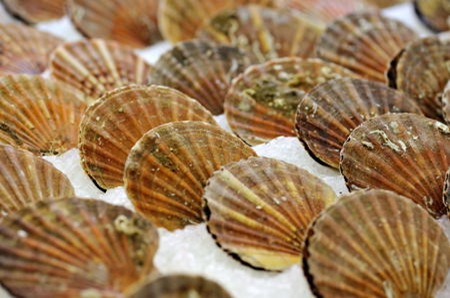
Sheep, pigs, rabbits, chickens, and horses abound…and the bounties of the sea are represented as well. The region of Brittany had a vast display of ultra fresh fish…county fair 5 …interspersed with an artfully-arranged selection of shellfish…
countyfair 4 
As for pigs…pen after pen was filled with the real thing…
countyfair 12 …and there were also some not so real piggies…countyfair 14 All the food groups were represented…wheat for making those fabulous baguettes…and fruit…here’s a stand full of bananas from Martinique…
countyfair 15

Technically not part of a food group, but definitely an essential part of any French diet… wine…there was plenty of du vin at the salon…

countyfair 3 Non-essentials were there, too…like confiseries
countyfair 9 If you have never had a French bonbon…brace yourself…they are really, really sweet!

There were numerous educational displays that explained all that went into the care and raising of the various animals and then there were other displays that were more intent on seeing that you enjoyed the results in a more timely manner…
countyfair 13jambon is French for “ham”.

There was every type of saucisson…or sausage…imaginable…
countyfair1…including some that were à la truffe…accented with hunks of truffle…
countyfair 17
As would be expected, cheese was very well-represented, but not just French cheese…there was Parmigiano-Reggiano, Pecorino Toscano, and Montasio varieties from Italy, Batzos and Kopanisti from Greece, and from Switzerland…countyfair 16 Appenzeller, Tomme Vaudoise, and enormous rounds of Gruyère.

Presenting all these delices were proud proprietors dressed in the traditional costumes of their particular region…including this woman from Berry…

countyfair 6   …and this man from Finistère…
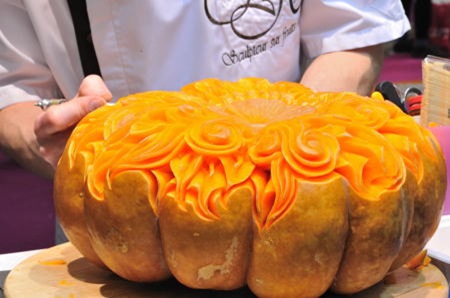
countyfair 21 And, of course, no county fair would be complete without someone doing the “it slices…it dices” routine…only in France, the end result is a bit more ornate…
countyfair7 …melons are swirled so that they are hardly recognizable as melons…and a French jack-o-lantern…
countyfair8 …is anything but rustic.

All this effort is made in the hopes of being awarded one of the coveted prizes…countyfair 22   …in this case, the lucky winner was Elysee, a pig from Normandy.

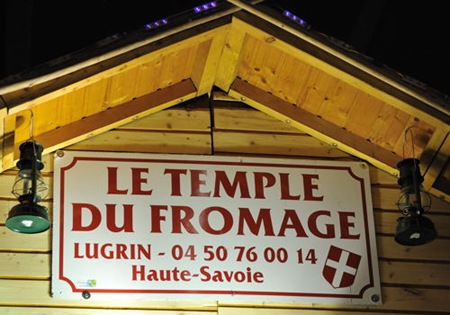
After making our way through the several huge halls filled to the brim with enticing exhibits and with our arms laden with bags full of products,  we capped off our day at Paris’ version of a county fair by visiting…

countyfair 19 …the cheese temple…for a bit of raclette authentique…
countyfair 18.not to mention une vrai fondue savoyarde

countyfair 20 

Stay tuned for more behind the scenes adventures of The Meadows Collection…or check out the results at www.meadowscollection.com